
Directory Routes Across Wake County
Wake County people directories do not form one master list. They describe narrow groups: a city contact directory lists public roles, a school directory lists district personnel, and an ownership roll lists the person or entity tied to land. Historical volumes capture listed occupants at the time an edition was printed. Choose the source by the relationship you need to prove, then save its date.
| Local directory | People or roles indexed | Official keeper | How to consult it |
|---|---|---|---|
| Raleigh staff directory | City staff and service contacts | City of Raleigh | Free search and A-Z browse |
| WCPSS directory | School and district personnel | Wake County Public School System | Free name or keyword search |
| N.C. employee directory | Published state agency contacts | North Carolina | Free name and agency search |
| Wake property roll | Titled property owners | Wake Tax Administration | Free owner, address, REID, or PIN search |
| Recorded-party index | Grantors, grantees, and other instrument parties | Wake Register of Deeds | Modern and historical indexes |
| Suburban and reverse volumes | Listed residents and occupants by edition | Olivia Raney Local History Library | Catalog plus onsite, often noncirculating, use |
Start with Raleigh or another municipality for a city role, WCPSS for a school contact, and the state directory for an agency contact. An owner search belongs in the tax roll. A past resident is more likely to appear in a reverse directory, newspaper, yearbook, census, or cemetery record. Absence proves little because each directory includes only its own population.
Search Wake Government Directories
The Raleigh directory supports keyword search, a field control, department browsing, and A-Z links. Entries can show a person or office, public role, department, telephone, and an email or contact link. Wake County publishes department contacts and board rosters instead of one comparable employee-name database. Other municipalities in Wake County maintain their own staff, department, council, and appointed-board pages.
The source view matters. The Wake County department directory is the safe fallback when a name does not appear. Call the main department contact or ask for the current office responsible for the service. Council agendas and minutes can preserve the names of former officials, board members, petitioners, and speakers after a live directory changes.
The official Raleigh staff directory shows the fields and browse tools available to a Wake County directory search.
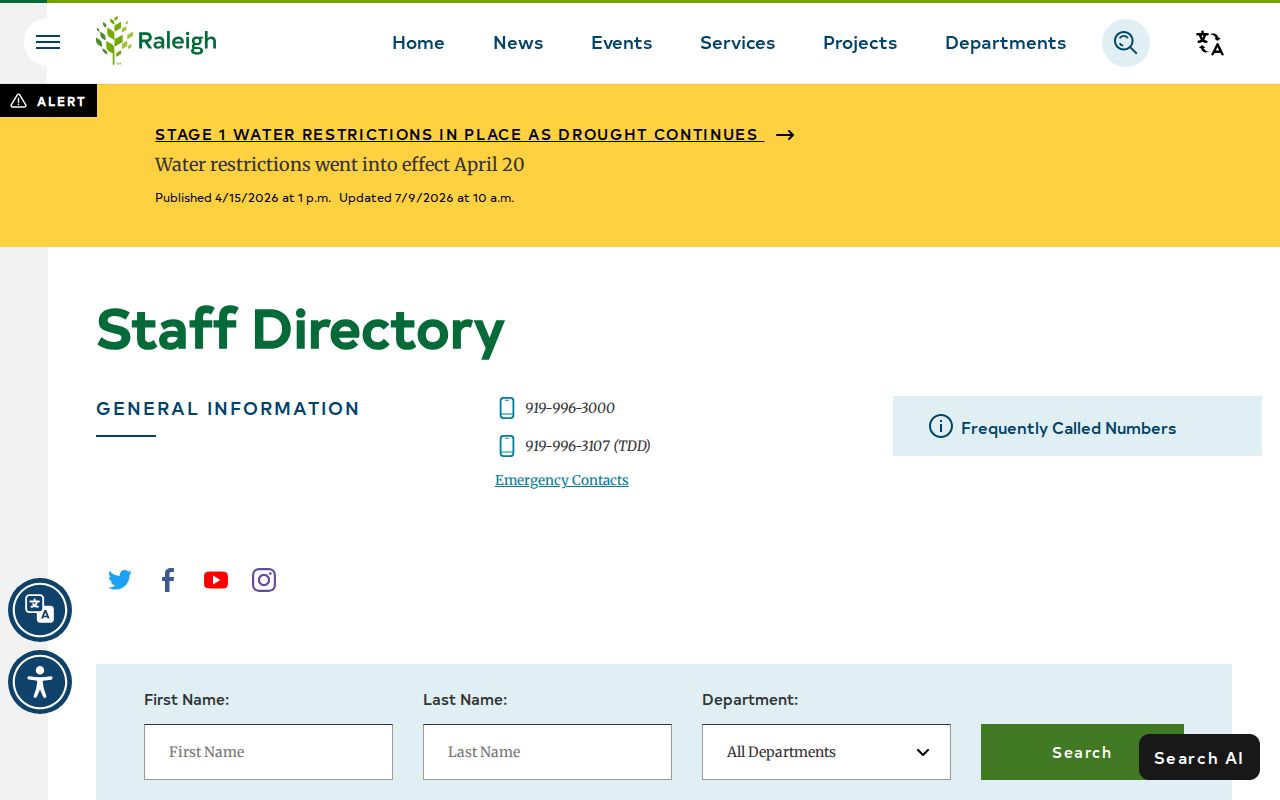
A result confirms a published public contact role on the retrieval date. It does not establish where the person lives.
Wake School Directory Fields
The WCPSS directory is Wake County’s largest verified education directory. It reported 17,011 entries during research, so a broad surname can be noisy. Narrow the search by first name, location, department, or known school. One person may have more than one title or assignment, and the location line is essential. Nearby university directories can confirm a public campus role, but they do not prove Wake County residence.
| Search control | Entry method | Practical use |
|---|---|---|
| Keyword | Free text | Searches constituent content |
| First Name | Given name | Narrows a common surname |
| Last Name | Surname | Primary person search |
| Pagination | Page links | Moves through large result sets |
A directory entry may list display name, title, school or other location, department, published email, and school telephone. The district footer is not evidence of a particular assignment.
The WCPSS directory screenshot shows why school and department filters matter.
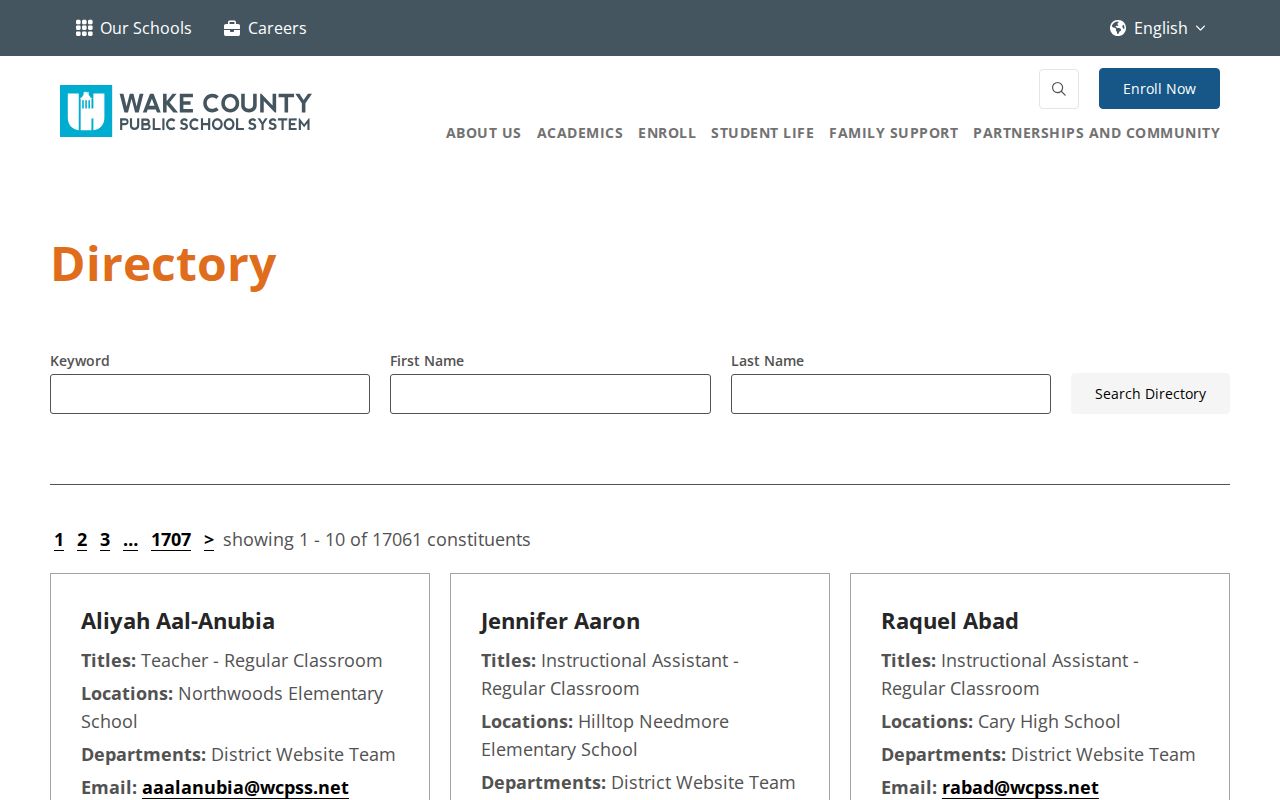
Record the exact location and title beside the name so two people with similar names are not merged.
North Carolina Agency Directory Search
Raleigh’s role as state capital makes the North Carolina employee directory especially useful within Wake County. Search First/Middle Name, Last Name, or Agency, then reset the form before trying a name variant. Public work contact fields vary by agency. An agency listing supports an official role, not a personal address or county of residence.
| Displayed identity | Published name, sometimes including a middle name or initial |
|---|---|
| Agency context | The state agency or unit attached to the contact |
| Work contact | Fields vary by agency and current publication practice |
| Match check | Use agency, middle identifier, and role before joining names |
The official state employee search illustrates its three main filters.
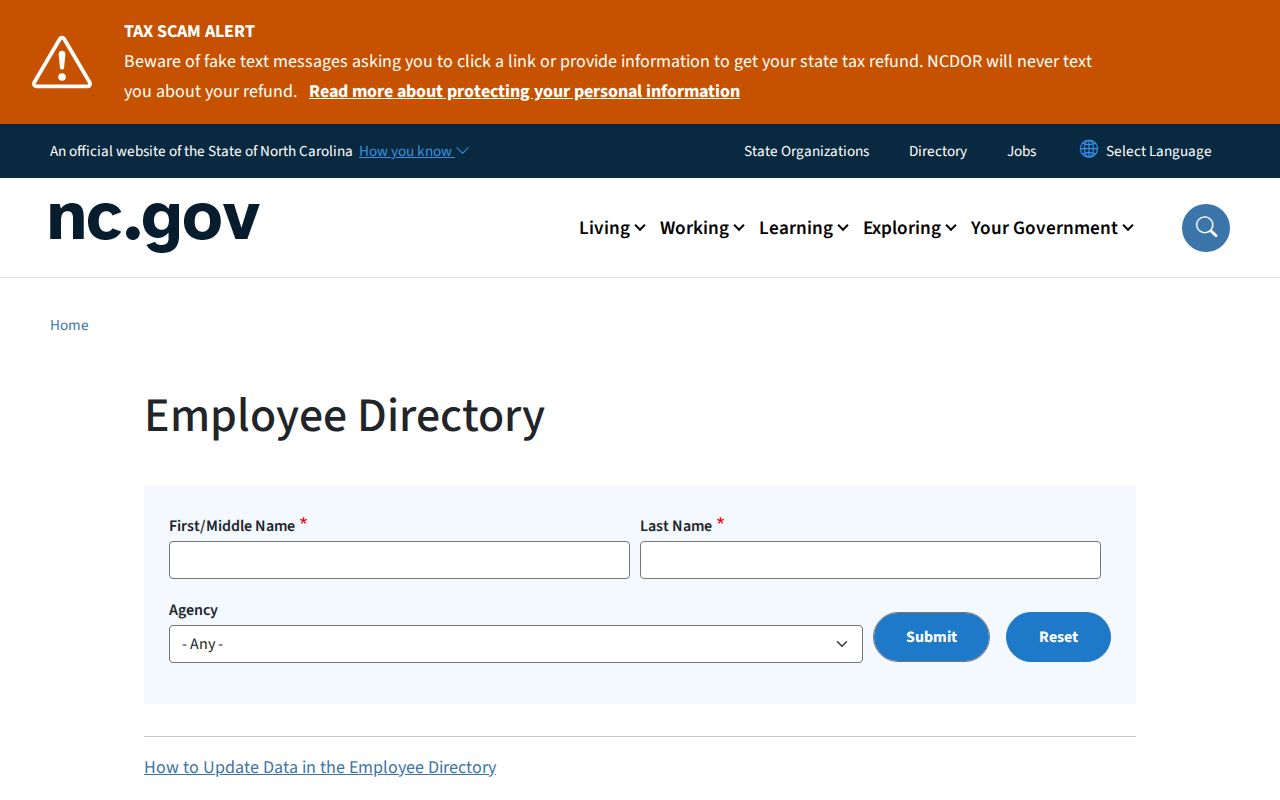
Try a partial first or middle name and select the agency when a full-name search misses a published listing.
Note: Directory records change as roles and assignments change, so save the retrieval date with every Wake County match.
Wake Records That Act Like Directories
Several Wake County public records work as people directories even though each was created for another purpose. The Register of Deeds index lists recorded parties and their roles, instrument type, date, and book/page or document number. The real-estate roll lists titled owners, mailing destinations, parcel identifiers, and deed references. The voter file covers registered and formerly registered voters but omits protected identifiers.
These populations must stay distinct. A grantor or grantee is a party to a deed. A tax owner holds title on the parcel record. A voter entry reflects registration status. None is a full resident list. For the access rules, copy routes, and protected fields behind these systems, use the Wake County public records system.
- Grantor and grantee
- The parties transferring and receiving an interest in a recorded instrument.
- Situs address
- The physical parcel location, which may differ from the owner’s mailing address.
- Reverse directory
- A volume arranged by address, allowing a street to lead to a listed occupant.
Owner Versus Occupant in Wake
A single Wake County address can yield three different people: the deed owner, the tax-mail recipient, and the reverse-directory occupant. That mismatch is useful. It may show an out-of-area owner, a trust, or an occupant who was not the title holder. Begin with Wake Real Estate or iMAPS to establish the parcel and current owner. Then select the directory edition closest to the date being researched.
Deeds trace title. Reverse volumes trace published occupancy. Permit and annexation files can add owner, applicant, or contractor names tied to a project date. A postal “Raleigh,” “Cary,” or “Apex” line does not settle municipal jurisdiction, so consult iMAPS layers before looking for a city permit directory. Tax-sale and foreclosure notices are dated event lists, not current resident rosters.
Compare at least two dated attributes before treating similar Wake County directory entries as the same person.
Note: Keep situs, mailing, ownership, and occupancy fields separate because each records a different relationship to the same Wake parcel.
Wake Business Name Directories
The N.C. Secretary of State entity search can expose legal name, SOS ID, status, formation date, entity type, registered agent, addresses, annual-report officials, and filed documents. Search an organization or an individual, then open the dated filing. A registered agent accepts legal service and is not necessarily an owner. Wake County directories for chambers or trade groups represent members, not every local business.
For trade names, the state assumed-name search covers filings made from December 1, 2017. Older names must be checked at the Register of Deeds. Search controls allow entity type, word matching, person-name fields, filing dates, and counties. A certified assumed-name copy comes from the Register where it was filed.
The official assumed-name interface shows the county and date controls that distinguish it from a simple company directory.
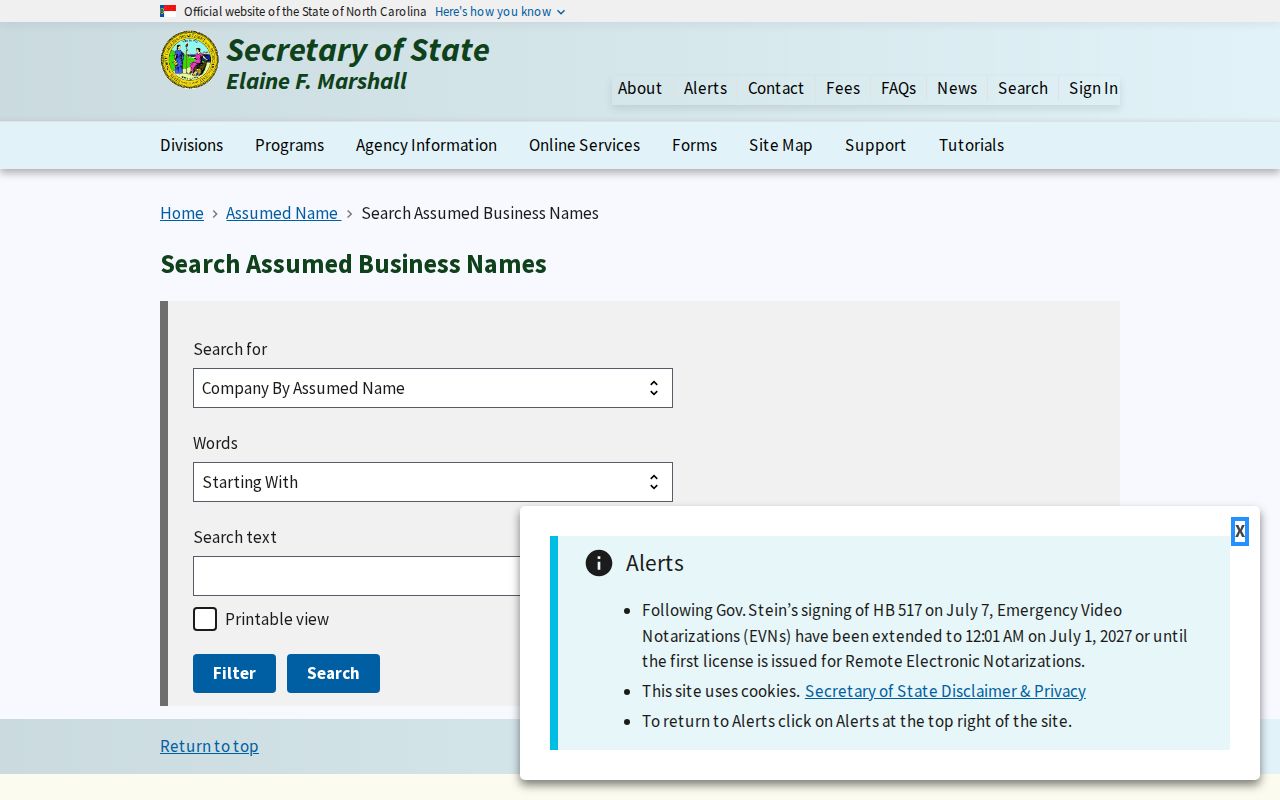
Preserve the filing date and county because a current trade name may have an older local record behind it.
Wake Professional Directory Checks
North Carolina has no one portal for all licensed professions. Use the official board that issued the credential. The State Bar, Medical Board, Board of Nursing, Real Estate Commission, contractor board, architecture and engineering boards, and other regulators publish different fields. A useful result includes the exact license number, status, and effective or inspection date. Public discipline and contact details vary by board.
The state license and permit directory routes users to the correct board. This is important in Wake County, where government, university, medical, engineering, and research institutions create many same-name collisions. Pair the name with a credential, agency, campus, or department. A board result proves only what that regulator reported on the day checked.
Note: Save the board name, license number, stated status, and retrieval date so a Wake professional-directory match can be checked later.
Wake Historical Directory Years
The Olivia Raney Local History Library is the county’s main local genealogy branch. Its Raleigh suburban and reverse-directory catalog record names R. L. Polk Company and Hill Directory Company. Verified holdings include scattered editions from 1986 through 2009 and Raleigh editions from 2020 through 2024. The catalog does not claim a complete year run, and many items are noncirculating.
| Directory range | Verified editions | Best use |
|---|---|---|
| 1980s | 1986, 1987, 1989 | Bridge address and surname listings |
| 1990s | 1990, 1993, 1994 | Track Triangle-era suburban change |
| 2000s | 2000, 2003, 2006, 2007, 2009 | Compare occupants across nearby editions |
| 2020s | 2020 through 2024 Raleigh editions | Recent printed address snapshots |
The catalog screenshot shows the specific Wake County directory holding rather than a generic local-history search.
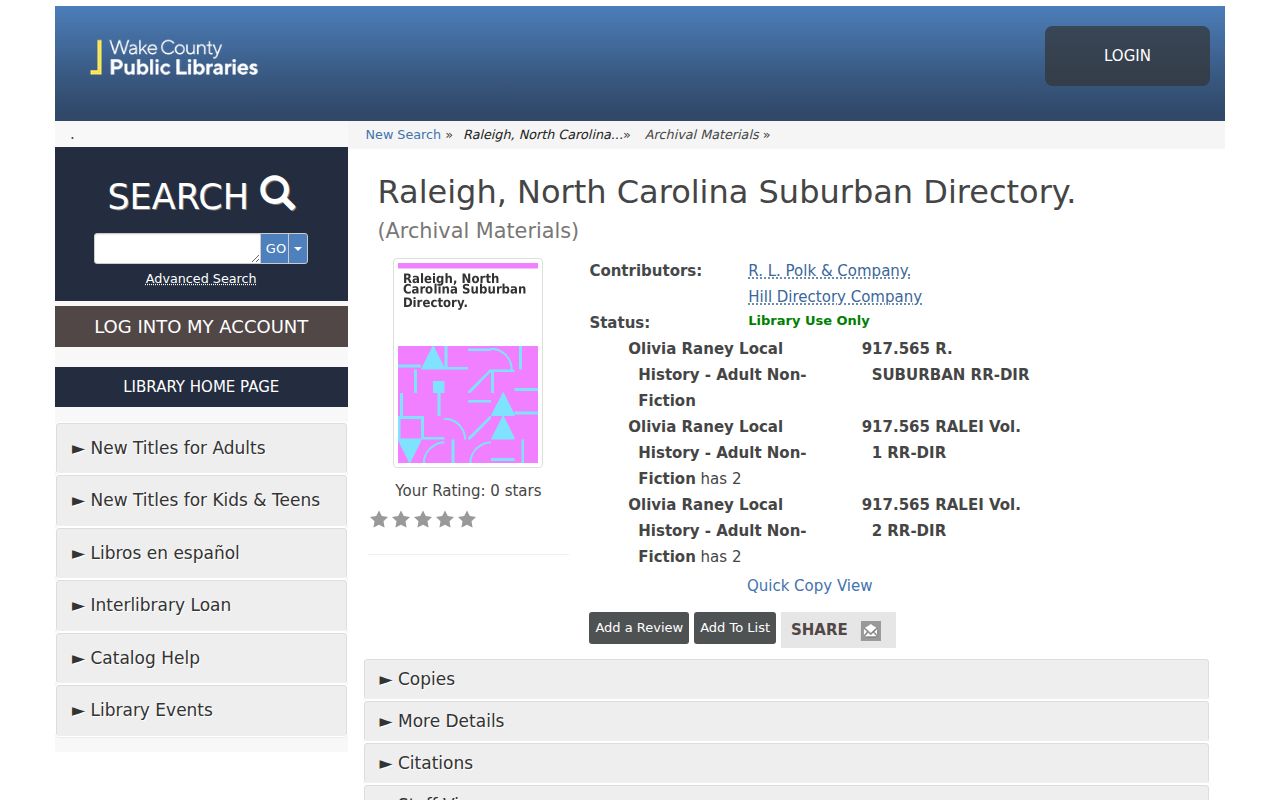
Confirm the volume year, location code, and onsite rules before visiting, then record the title, edition, and page with any finding.
Beyond Wake City Directories
Olivia Raney also holds Wake guardians’ accounts, court dockets, plats and maps, newspapers, yearbooks, and local files. Western Wake Herald microfilm begins in 1965, while a Cary News clipping group covers family events from 1991 through 1998. DigitalNC, cemetery registers, church records, preservation surveys, and nearby university finding aids widen the search when a printed directory has no match.
County formation sets an older boundary. Wake County began in 1771 from parts of Cumberland, Johnston, and Orange counties, so an earlier resident may appear under a predecessor jurisdiction. The Register’s historical deed index also includes a purpose-built Enslaved Persons Search with 2,156 references and dates reaching 1780. That index can surface names buried in deeds outside the usual grantor and grantee fields.
- Fix the person to an approximate year with a directory, census, deed, or newspaper.
- Search documented name variants and nearby directory editions.
- Translate the old address through parcel, plat, and deed evidence.
- Check obituary, estate, cemetery, and church records for family links.
- Move to predecessor-county sources for events before Wake County formed.
Modern people directories are fast, but the library and archives preserve context. The strongest Wake County result records both the searchable index and the underlying volume, image, or file.