
Which Wake County Records Are Open
Wake County public records are divided by function, not placed in one universal search. The Register of Deeds keeps recorded instruments and local certificates. Tax Administration maintains parcel and assessment data. The Clerk of Superior Court is the court, estate, and divorce-file custodian. State agencies run several statewide systems. This coverage chart puts the online route beside the office fallback so a missing web result does not end the search.
| Wake record group | Keeper | Web coverage | How access works |
|---|---|---|---|
| Deeds, liens, and plats | Wake Register of Deeds | Modern Self-Service plus deed books reaching the 1700s | Free index; office copies and certification |
| Property and tax | Wake Tax Administration | Current assessment with transfer and history displays | Free search; tax-office fallback |
| Court and estate files | Clerk of Superior Court | Statewide eCourts case data | Web docket; free terminal; file copies for a fee |
| Birth, death, and marriage | Register of Deeds and N.C. Vital Records | Request service, not a universal current name index | Certified-copy eligibility applies |
| Voter registration | Wake Board of Elections and NCSBE | Current lookup, weekly files, and historical snapshots | Free lookup and downloads; protected fields omitted |
| Custody and registries | Wake Sheriff, N.C. DAC, and N.C. SBI | Current agency-specific systems | Free searches; agency request fallback |
Open access has limits. Sealed and expunged cases, juvenile and adoption material, protected personal identifiers, active investigative material, and qualifying Address Confidentiality Program data do not become open merely because the agency keeps them. A current index may also be narrower than the underlying file. Inspection rights do not override a separate confidentiality law.
Chapter 132 in Wake County
North Carolina General Statutes Chapter 132 defines public records broadly and gives any person a right to inspect and obtain copies at reasonable times. Section 132-6 says a custodian must act “as promptly as possible.” It sets no fixed count of business days. An office may satisfy the copy duty through online view, print, or save tools, and it need not create a report or compile data that does not exist.
The General Assembly’s current Chapter 132 section index is the sound place to check the statute that applies to a request. A denial should identify its legal basis. A requester can ask for that explanation in writing, and Section 132-9 provides court enforcement. Specialized laws can still close part or all of a record.
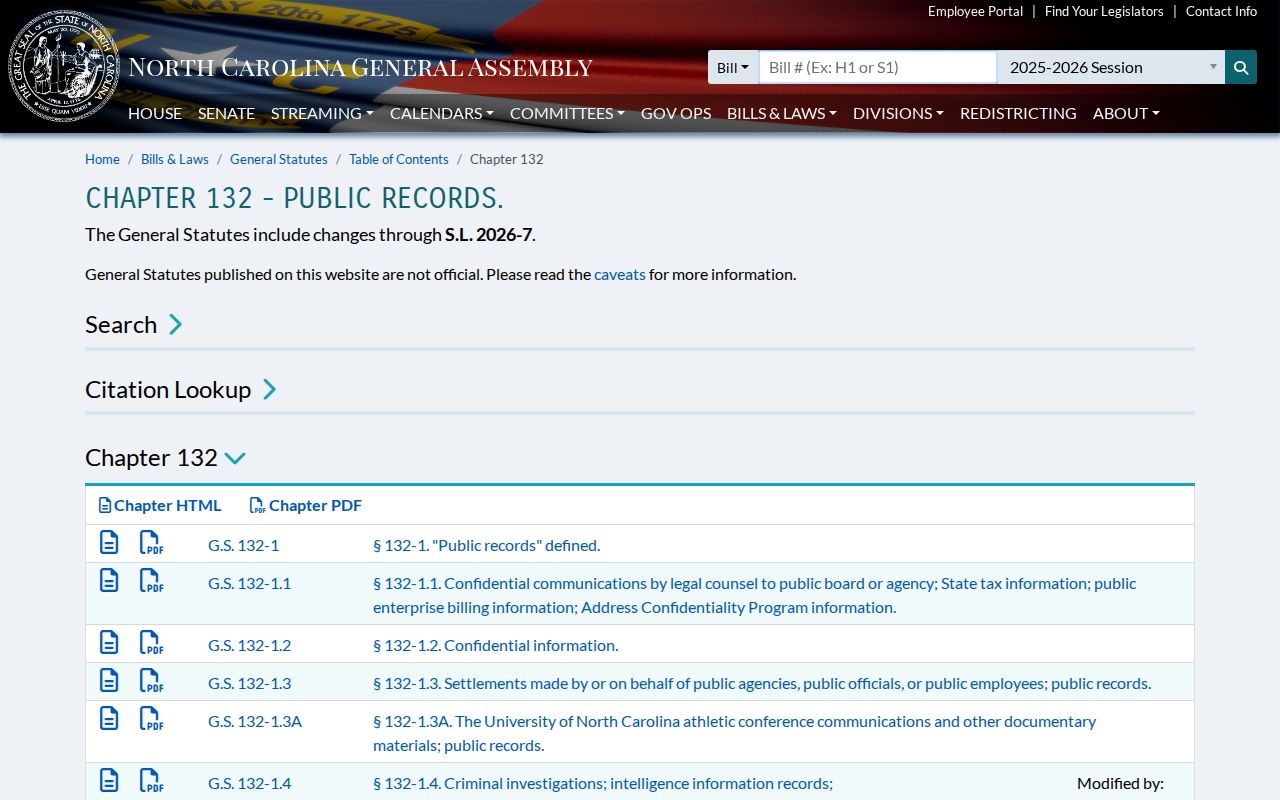
The captured statute index helps separate the general access rule from the exemptions and record-specific laws that control particular fields.
Note: “Promptly” depends on volume, storage, legal review, and format, so a careful request is often faster than a broad one.
Wake County Deed Record Indexes
The Wake County Register of Deeds office page routes searchers to recorded land documents, assumed names, marriage licenses, and vital certificates. Its modern index supports party, instrument, recording-date, and book-page searches. The Register calls the index a library-card catalog. That is a useful warning: search spelling variants, collect the book and page, then read the recorded image instead of treating one index row as the full instrument.
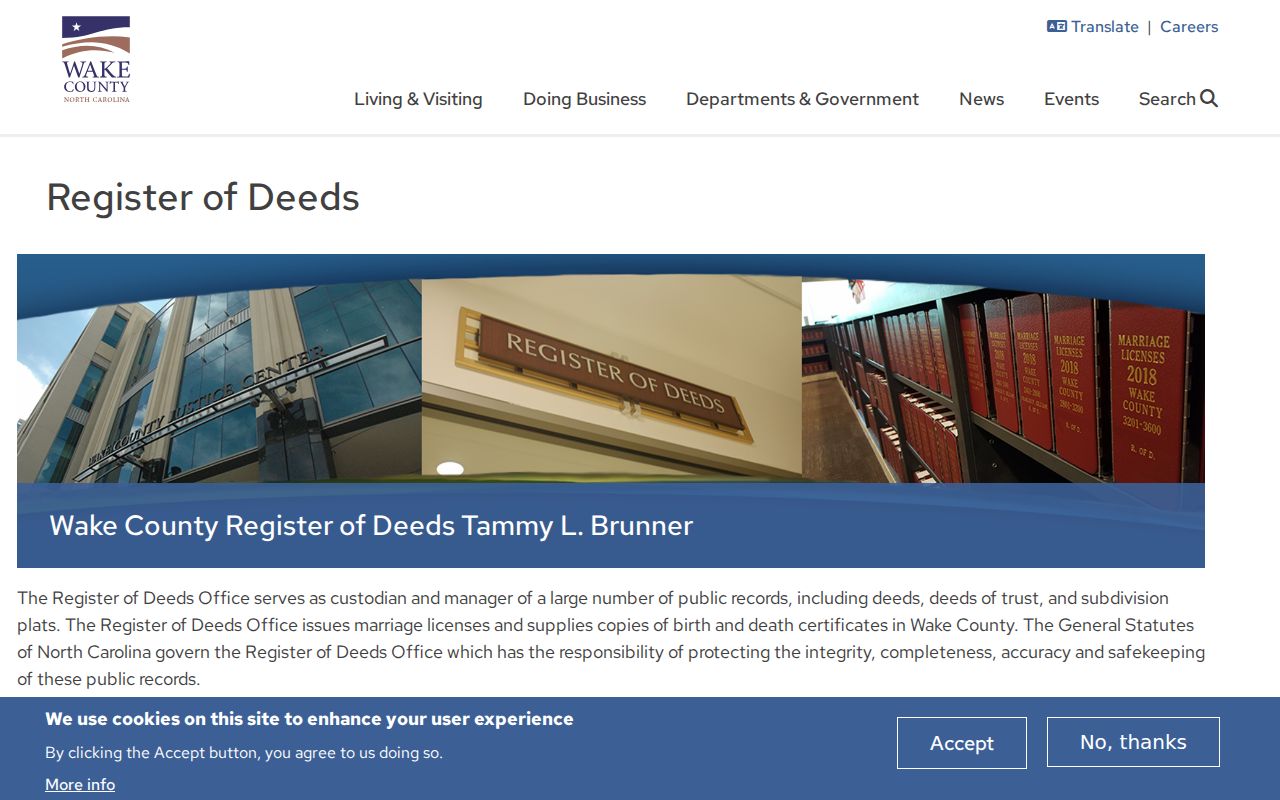
The office route matters when an image is unavailable, a certified instrument is needed, or a historical name does not surface in the modern system.
The historical Consolidated Real Property Index reaches eighteenth-century deed books. Its special Enslaved Persons Search held 2,156 entries at inspection and exposed names that ordinary grantor and grantee fields can miss. A result can show:
- Record ID and date
- Book, page, and DocId
- Grantor and grantee names
- Transcribed names of enslaved persons
- A route to the digitized image when available
The DocId joins the county, book, page, and image into a reproducible locator. The search accepts the controls recorded here:
| Search control | Input | Required | Choices or format |
|---|---|---|---|
| Search | Text | No | Entered name or term |
| Search by | Dropdown | No | All, Date, Book, Page, Grantor, Grantee, or Enslaved Person’s Name |
| Records per page | Dropdown | No | 15, 30, 60, or 100 |
Wake Property Records Need Context
The county’s parcel system distinguishes a property’s situs address from the owner mailing address used for tax correspondence. They answer different questions. A mailing address can point to a nonresident owner, but it does not prove where that person lives. Parcel results can include owner names, REID and PIN identifiers, deed book and page, transfer date, values, legal description, and links to sales and billing data.
The Wake Tax Administration page supplies the official office route when the online parcel card is unclear or historical data is needed.

The live search accepts owner, address, REID, or PIN. iMAPS adds parcel boundaries, civic districts, aerial layers, and municipal jurisdiction. Neither GIS geometry nor a tax card substitutes for a recorded deed or survey. A recent transfer can also appear in the Register before the tax display updates.
Wake Court Records Beyond eCourts
Wake District and Superior Court cases use North Carolina’s unified system. All 100 counties completed Odyssey and eCourts conversion on October 13, 2025. Smart Search accepts a party name or case number, with optional county, case category, status, and date filters. A docket can show the case caption, number, party roles, status, hearings, events, and dispositions when those fields are public.
The Judicial Branch court-record access instructions preserve the fallback that a portal cannot replace.
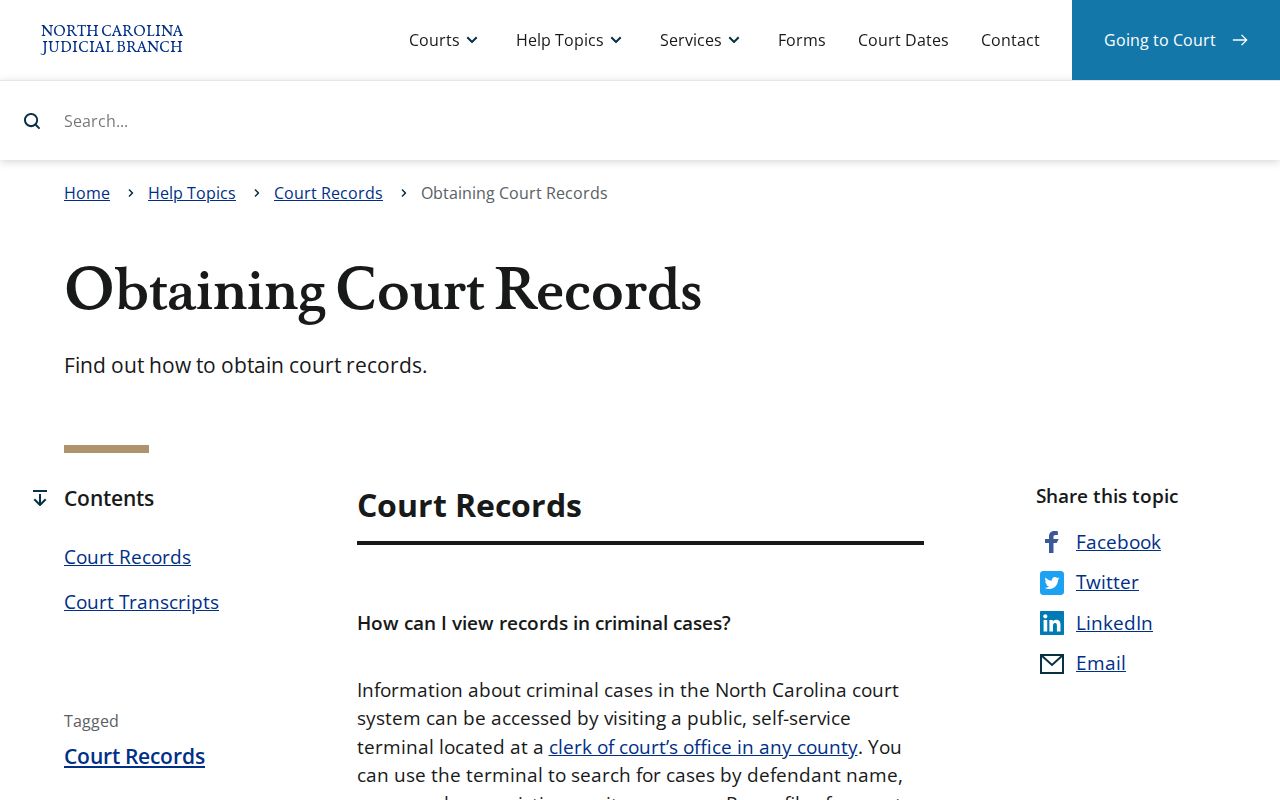
A public self-service terminal can search criminal matters by defendant, case number, or victim or witness name. Civil, estate, and special-proceeding data are also available at terminals. The Clerk of Superior Court provides the actual case file and paid copies in the county where the matter lies. Older files may require staff retrieval. Sealed, juvenile, adoption, and expunged matters do not appear as ordinary open cases.
Note: A missing portal result does not prove that no case exists; check name variants, county, the clerk terminal, and archived files.
Wake Vital Record Copy Limits
There is no universal current public name portal for Wake birth, death, marriage, and divorce certificates. Start with the Register of Deeds for a Wake birth, death, or Wake-issued marriage record. Use N.C. Vital Records for a statewide search. A divorce judgment belongs to the Clerk of Superior Court, while the state certificate is only a summary of that court event.
Under N.C.G.S. §130A-93, certified copies are available to the registrant, spouse, sibling, direct ancestor or descendant, stepparent or stepchild, an authorized representative, or a person who needs the information for a legal determination. The current Wake certificate request form lists a $10 charge for each certified birth, death, or Wake-issued marriage certificate. Uncertified copies may be supplied with statutory redactions.
For older events, use archival county guides, delayed-birth series, church registers, newspapers, cemetery sources, and genealogy indexes. Those sources can corroborate an event, but they do not replace a certified certificate.
No simple age rule. North Carolina law does not state a blanket rule that births open after 100 years or deaths after 50. Historical indexes and archival transfers expand research access, but certificate eligibility still requires a legal check.
Wake Custody and Registry Records
Law-enforcement information follows several channels. The Wake County Sheriff’s Office handles local arrest, detention, incident, and county-area material. The N.C. Department of Adult Correction lookup covers state prison, probation, and parole records. The N.C. SBI registry offers name and map-based searches. Each system has a distinct scope, so none is a complete court history.
- Ask the Sheriff records unit for releasable Wake arrest or incident material that is not posted online.
- Use the state offender search for an offender number, status, sentence, location, release, or supervision information.
- Confirm registry results on the individual record and with the sheriff when current status matters.
- Verify charges and final dispositions through eCourts and the clerk because an arrest is not a conviction.
Wake planned to stop publishing online mugshots and daily arrest reports in August 2026 because expunction updates were not reaching the separate publication system reliably. That channel change does not repeal the public basic-arrest facts described in §132-1.4(c). It makes the Sheriff and clerk routes more important when proactive web publication ends.
Wake County Records Offices Online
Raleigh is both the county seat and state capital, so several layers of government operate in one place. Start with the office that created the record. The Wake County department directory is the official routing source for public records and county contact channels.
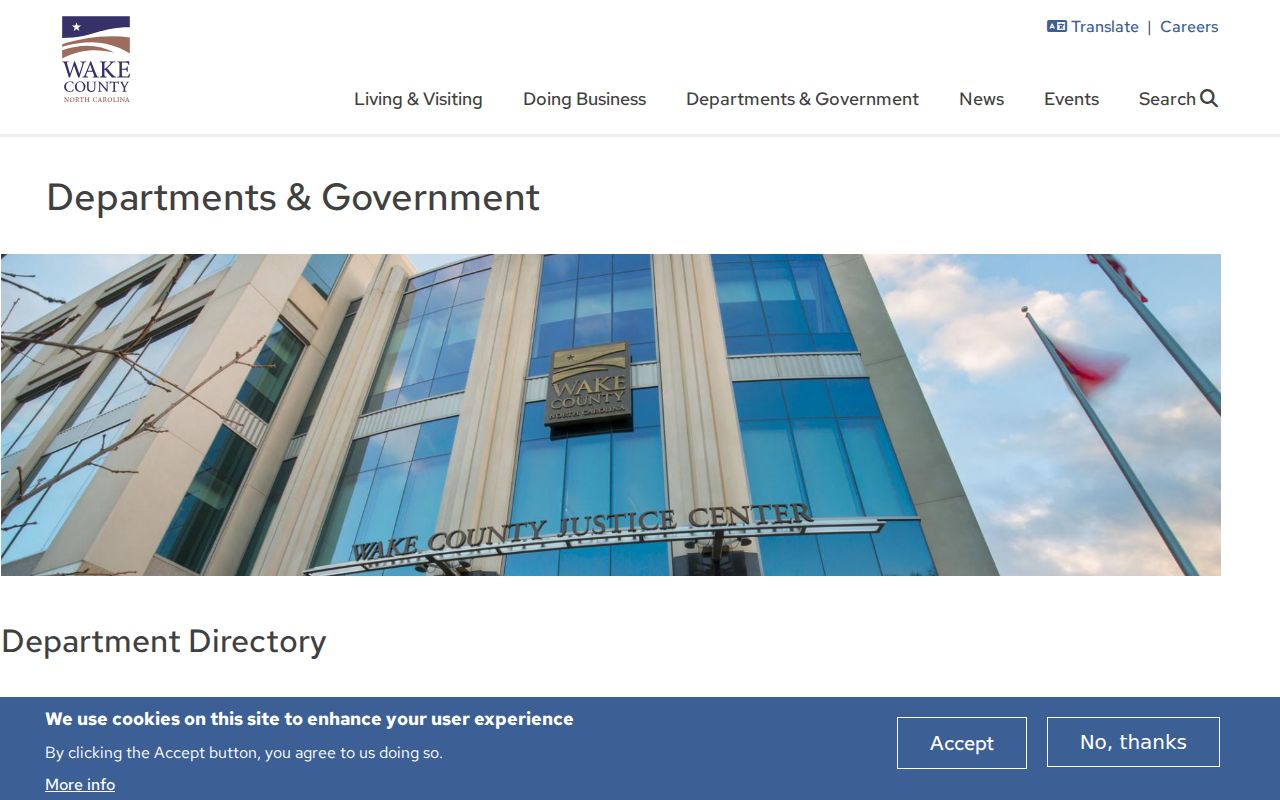
The directory screenshot shows why a department-based request is more precise than sending a broad inquiry to a generic county address.
Wake Register of Deeds
Recorded instruments, assumed names, marriage licenses, and Wake vital certificates
Online index, office, and mail channels
Access: Self-Service Records Search
Wake Tax Administration
301 S. McDowell St., Suite 3800, Raleigh
919-856-5400
Access: Wake Real Estate Search
Wake Clerk of Superior Court
Civil, criminal, estate, special-proceeding, and divorce court files
Portal, public terminal, file inspection, and copies
Access: Statewide eCourts Portal
Tax Administration publishes weekday hours of 8:30 a.m. to 5:15 p.m.; confirm before visiting. For court and Register service, use the current office page before a trip because room assignments, counter rules, and processing channels can change.
Wake Records Cross City Lines
A Raleigh, Cary, Apex, Wake Forest, or other postal city label does not settle which local government keeps a permit, planning case, council file, or police report. Wake contains incorporated areas, unincorporated communities, annexation pockets, and extraterritorial planning jurisdictions. Use parcel and jurisdiction layers to identify the government that created the material before sending a request.
County deeds, property tax records, and state court files remain with their Wake custodians even when municipal limits shift. City-created records stay with the applicable city department. For a police incident, contact the agency serving the incident location. For permits, use the municipal or Wake planning authority shown by the parcel’s actual jurisdiction, not just its mailing city.
Note: A postal address can be valid while pointing to the wrong government office for permits, police files, or annexation records.
Wake Records Fees and Copy Types
Section 132-6.2 limits an ordinary uncertified copy of public records to the agency’s actual reproduction cost. An office may add a reasonable actual-cost special service charge when a request requires extensive technology, clerical work, or supervision. Ask for the estimate and its basis before work begins. Inspection or an existing electronic file can avoid costs when either format meets the need.
Copy type matters. A plain image is useful for research. A certified copy carries the custodian’s authentication and may have a separate statutory fee. Vital certificates have both eligibility and fee rules. Court copies and certification are obtained through the clerk. If a database request requires extensive extraction, ask for native electronic format and existing field definitions rather than a newly designed report.
- Index
- A finding aid that points to a record but may omit context from the source document.
- Certified copy
- A custodian-authenticated reproduction, distinct from a saved portal image.
- Custodian
- The agency or official responsible for keeping and providing a record.
- Exemption
- A law that permits or requires material to be withheld or redacted.
Request Wake County Public Records
A strong request names an existing record series, a date range, the relevant person or address, and the desired format. It also reaches the right custodian. Asking for every fact about one person invites delay because no single Wake office owns that compilation. Use a case number, REID or PIN, book and page, instrument number, or incident number when one is known.
- Confirm jurisdiction and identify the department that created the record.
- Search the official index and collect stable record identifiers.
- Ask for the existing record, date span, and electronic or inspection format through that office’s portal, form, mail, or counter channel.
- Request a cost estimate before extensive work and state whether certification is required.
- If access is denied, ask for the statutory basis in writing and for reasonably separable nonexempt parts.
Judicial Branch administrative requests use the court system’s records-request channel, but an individual Wake case file still comes from the Clerk of Superior Court. Municipal files go to the city or town department. Register documents use portal identifiers, while historical cards, maps, or county datasets should identify the parcel and relevant year.
Use records lawfully. Open access does not permit stalking, threats, intimidation, or harassment. Respect protected addresses and do not republish sensitive identities simply because an index can locate them.
Wake Record Alerts Versus Proof
Wake’s free Document Recording Alert can notify an enrolled user when a matching name appears in a new recorded document. It is a monitoring aid, not a title search, fraud finding, or guarantee. Review the instrument among the county’s public records and compare its parties, book and page, parcel, and later releases or corrections before drawing a conclusion.
Official indexes also help test suspicious mail. A high-priced deed-copy offer may quote accurate public facts, but accuracy does not prove the sender is official. Compare the document number and owner spelling with the county record. Find the office phone on a government page instead of using the number in the letter. Preserve the envelope, URL, and payment demand if impersonation or fraud may need to be reported.
Note: A recording alert can miss name variants, so keep enrolled terms current and review official instruments before acting.